
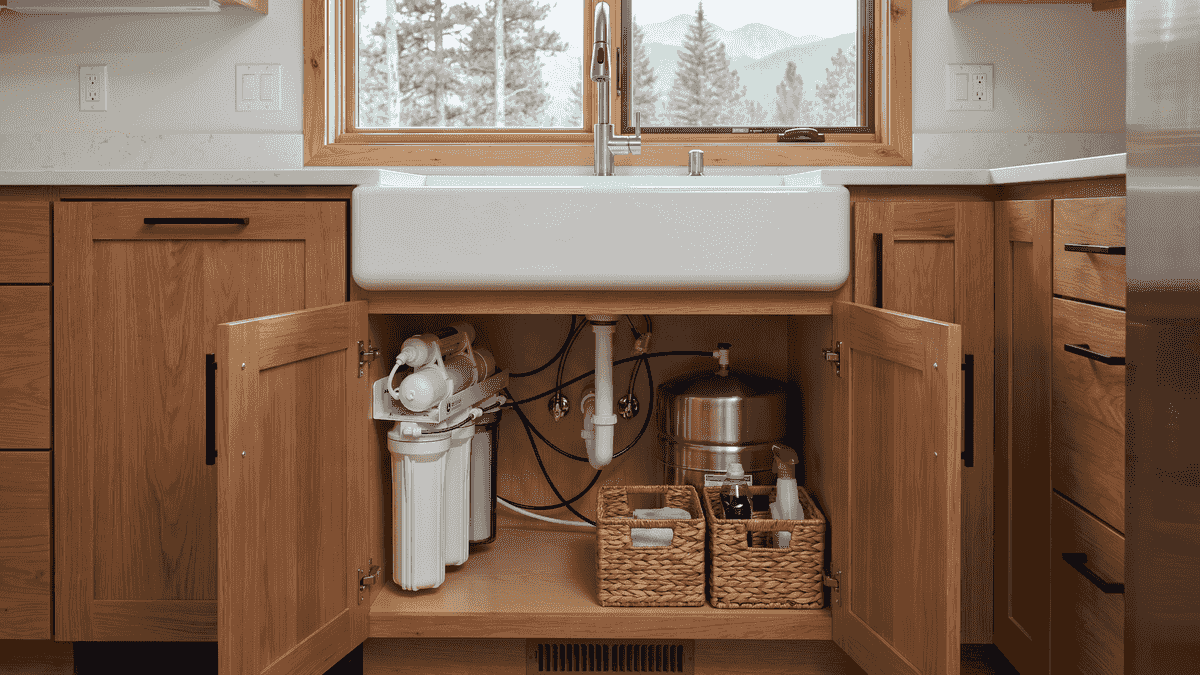
 Reverse Osmosis
Service area · Clear Creek Canyon foothills
Idaho Springs water treatment built for the I-70 mountain corridor
Idaho Springs is a historic Clear Creek County mountain town at the mouth of the Clear Creek Canyon, roughly 30 miles west of Denver on I-70 at about 7,500 feet — the eastern gateway to the Rocky Mountain high country and a community where the in-town service area is small but the surrounding mountain slopes are alive with private wells. The wells tap fractured Precambrian granite and metamorphic rock along the foothills, and that geology puts hardness, iron, manganese, and acidic low-pH water into the groundwater — with radon in the mix on top. The treatment that actually works here is the treatment designed around what your specific mountain well delivers.
- Clear Creek CanyonFractured granite + metamorphic wells
- Acidic + Iron + RadonLow pH, mineral-rich, foothills radon belt
- Free On-Site TestingFree water analysis, scheduled fast
The Clear Creek water story
Why Idaho Springs well water needs to be tested — not assumed
Idaho Springs sits at the mouth of the Clear Creek Canyon where the Front Range climbs west of Denver toward the Continental Divide. The in-town service area is small — a historic main street and the community water system pulling surface water from the Clear Creek watershed. Step off that service area and almost every home climbs onto a private well tapping the fractured Precambrian granite and metamorphic rock the foothills corridor runs through — exactly the geology that puts hardness, iron, and manganese into the groundwater at predictable but uneven ratios well by well.
The water that comes out of a mountain well above town is mineral-rich and characteristically acidic. Calcium and magnesium stack up as hardness, iron comes through as the orange staining homeowners see on faucets and laundry, and manganese shows up as the dark staining that won't bleach out. Low pH is the part of the Clear Creek water story that sneaks up on homeowners: the water looks fine, but it's quietly corroding copper plumbing and pulling lead from older solder joints. Add in the seasonal peaks — turbidity and sediment after the spring snowmelt and the summer monsoon thunderstorms that roll down the canyon — plus radon dissolving into groundwater from the surrounding rock, plus coliform bacteria in shallow wells that take surface water after a storm — and a treatment system designed for someone else's water almost never fits yours. We start every Idaho Springs job with a real on-site analysis and design from the results.
- Hardness, iron, and manganese from fractured Precambrian granite and metamorphic rock
- Low pH / acidic water that corrodes copper plumbing and leaches lead from older solder
- Turbidity and sediment after spring snowmelt and summer monsoon storms
- Coliform bacteria in shallow wells with surface-water infiltration from the canyon
- Radon in water — the Clear Creek foothills are a known radon-in-water belt
- Lead and copper from older galvanized service lines and original brass plumbing

How Water Works helps
Treatment designed around what your mountain well actually contains
For most Idaho Springs homes and cabins, the right answer is a layered system: a softener at the point of entry to handle hardness and protect appliances, plus a neutralizer ahead of the softener to correct the low pH that's quietly eating the copper plumbing. Wells with iron and manganese need a dedicated oxidation filter or greensand stage between the neutralizer and the softener, and homes where radon is present at treatable levels typically add an aeration or granular activated carbon stage specifically for radon — paired with proper venting, since the gas has to leave the water before it can leave the house.
Drinking water matters separately. A reverse osmosis unit at the kitchen tap pulls out the trace contaminants that whole-house treatment isn't designed to address — radon daughters, residual metals, anything the softener and carbon stages have already reduced but not eliminated. We design the system, install it, and verify the treated water meets the mark at every tap it's used. Then we come back: well water should be tested at least once a year, and we keep your system serviced and your water verified season after season.
- Free on-site water analysis
- Water softeners sized to foothills hardness
- Acid neutralizers for low-pH water
- Iron and manganese filtration
- Radon-in-water reduction
- UV disinfection for bacteria
- Reverse osmosis for drinking-water taps
- Annual testing and ongoing service
Coverage across Clear Creek County
Service routes into the I-70 mountain corridor
Idaho Springs' position on the map is what determines how service routes to it. The town sits roughly 30 miles west of Denver on I-70, far enough into the foothills that it lives outside any metro water district but close enough that the Denver Metro office treats the run up Clear Creek Canyon as a routine day. Our service techs leave Denver, climb west on I-70 past the Floyd Hill switchbacks, and arrive in Idaho Springs as a normal scheduled stop — not a special trip. Most of the surrounding mountain homes and cabins are on private wells that nobody but us is testing.
Coverage out of the Denver Metro office runs the I-70 corridor west into Clear Creek County and up the canyon — Black Hawk and Central City over the hill to the south, Georgetown and Silver Plume further up the valley, Empire and Dumont back down toward the Junction. The mountain properties scattered between those towns and the homes tucked into the side canyons off the main highway all sit on the same foothills geology, with the same basic contamination profile, and on-site well testing, system design, and install work are routine jobs for the crew. We keep every install on an annual testing cycle because the contamination profile on Clear Creek wells shifts with seasonal runoff and the monsoons that roll down the canyon.
- Denver Metro office — west on I-70 into Clear Creek County
- Scheduled routes to Black Hawk, Central City, Georgetown, Silver Plume, Empire, and Dumont
- Statewide dispatch for the further-out canyon properties and high-country homes
- On-site well testing, softener installs, and RO work on mountain properties
- Longer plumbing runs and higher elevations sized into every install
- Annual testing programs across the Clear Creek foothills
Idaho Springs water treatment FAQs
Is Idaho Springs' tap water safe to drink?
It depends on which tap. The historic downtown core sits inside a small community water system pulling surface water from the Clear Creek watershed, and that supply meets regulatory standards. But the in-town service area is small, and almost every property on the surrounding mountain slopes runs on a private well tapping fractured Precambrian granite and metamorphic rock. Well water isn't regulated the way city water is, so there's no required routine testing unless the homeowner arranges it. 'Safe by the standard' and 'good at your kitchen tap' are not the same thing — only a real on-site analysis tells you what's actually coming out of your faucet.
What contaminants are most common in Idaho Springs well water?
Foothills wells along the Clear Creek corridor tap fractured Precambrian granite and metamorphic formations that put hardness, iron, and manganese into the groundwater at characteristic ratios. Low pH is the part of the Clear Creek water story that sneaks up on homeowners: the water looks fine, but it's quietly acidic, corroding copper plumbing and pulling lead from older solder joints. Turbidity and sediment spike after the spring snowmelt and summer monsoon thunderstorms that roll down the canyon, coliform bacteria show up in shallow wells after surface water finds its way in, and the foothills above Clear Creek are a known radon-in-water belt — radon dissolves into the groundwater straight from the surrounding rock. Older homes in the older parts of town can also still pull lead and copper from galvanized service lines and original brass plumbing. A real on-site analysis is the only way to know which of these your well actually has.
How often should I test my water in Idaho Springs?
At least once a year for any private well — and more often if you've ever had a positive result, if your well runs shallow or sits close to the creek, or if your water changes in taste, smell, or color. Radon in water and coliform bacteria are the two contaminants we test for most often in Clear Creek County foothills wells, and both reward consistent annual testing rather than a one-time check. Spring snowmelt and the summer monsoon churn the shallow aquifers along the canyon walls, so test again after any major storm event. Homes on the small in-town community system should still test at the tap every few years to catch plumbing-related contamination the utility doesn't see.
Do Idaho Springs homes really need a water softener?
Yes. Granite-aquifer water in the Clear Creek foothills is mineral-heavy, and very hard water is the rule on the mountain properties ringing the town, not the exception. You'll see it as spotting on glassware, scale on faucets and shower glass, and shortened lifespans for water heaters and dishwashers. Low pH complicates the picture: most mountain homes also need a neutralizer to raise the pH and protect copper plumbing, and many pair the softener with a dedicated iron filter to handle the orange staining that comes with foothills wells. Salt-free conditioners help with scale, but they don't actually remove the hardness minerals the way a proper ion-exchange softener does.
Can you service my home outside of Idaho Springs?
Yes. Our Denver Metro office covers Idaho Springs and the surrounding Clear Creek County communities along the foothills and the I-70 mountain corridor — Black Hawk, Central City, Georgetown, Silver Plume, Empire, and Dumont — with scheduled routes that include the longer service runs and higher elevations that mountain properties typically need. On-site well testing, system design, and installation are routine work for that crew. Statewide dispatch out of our four regional offices covers anything further out along the corridor or over the hill.
Get a free water analysis in Idaho Springs
Find out what's actually in your water — in-town community supply, canyon-side well, or older home with original plumbing. We'll test on-site, walk you through the results, and design a treatment system around your source, your household, and your preferences. Schedule with our Denver Metro office at (303) 248-3390 for fast coverage across Idaho Springs and the Clear Creek County mountain corridor, or use statewide dispatch through any of our four regional offices.
Get a quote- Denver Metro(303) 248-3390
- Northern Colorado(970) 381-4493
- Colorado Springs Metro(719) 694-2650
- Pueblo & S Colorado(719) 836-8118
From the blog